

Showing posts with label caribou. Show all posts
Showing posts with label caribou. Show all posts
Sunday, May 05, 2013


Tuesday, June 30, 2009
Remembering Beaumont Hamel,July 1,1916
A few photos i recently shot. Info of them taken from the web.

CARIBOU Bowring Park's Caribou stands atop an outcrop of rock nestled within a grove of trees, overlooking a shimmering waterfall and a serene, limpid pool. It is a perfectly natural location for this majestic monument, because this Caribou, the symbol of the Royal Newfoundland Regiment, is a replica of a woodland caribou. Woodland caribou live a mostly solitary life in the forest, unlike the barren-roaming herds our province is usually noted for. The Royal Newfoundland Regiment, which celebrates its bicentennial in 1995, possesses a long and distinguished history. However, it seems that one event in particular has become synonymous with the Regiment: the tragic battle at Beaumont Hamel, which occurred on July 1, 1916. On that fateful day 752 young Newfoundlanders went "over the top," pouring out of their trenches toward the German front line. The brave young soldiers, picking their way over barbed wire and trenches, were unaware of the impending doom they marched towards. Approximately one hundred feet behind the enemy line, hundreds of German troops were hiding and waiting to reinforce their position. This German unit was known as the 6th (Brandenburg) Division, aptly nicknamed the "Iron Division." When the Newfoundland troops came into sight, they were attacked head on, blasted by heavy shelling and sprayed with machine gun fire; yet they continued their march with unshakeable resolve and overwhelming courage. By the end of the day, only 68 of the Regiment, which had numbered 802, remained unharmed, the rest either wounded or killed. July 1 is, of course, celebrated as Canada Day in our country. But for Newfoundlanders, July 1 is also Memorial Day, in honour and remembrance of the many young Newfoundlanders who answered the call to arms and made the ultimate sacrifice on that day in 1916. Before going to war in 1914, the Newfoundland contingent adopted the woodland caribou as its official emblem. In recognition of their battle at Beaumont Hamel, a life size caribou monument was erected there, overlooking the actual place where so many died. There are also two other such monuments in France, as well as two in Belgium, commemorating the Regiment's role in World War I. The Caribou monument which stands in Bowring Park was a gift of Major William Howe Green. It was presented as a tribute to the Royal Newfoundland Regiment, with whom Major Green served as Musketry Instructor during World War I. Major Green resided in St. John's for a number of years. A successful architect, he designed several buildings in the St. John's area, including the famed Cabot Tower on Signal Hill. The bronze memorial was sculpted by Bazil Gotto, and Rudolph Cochius, the man who designed Bowring Park, chose its location and supervised its erection, approximately 100 yards north of the Bungalow. Mr. Cochius had also been responsible for designing the layout of Beaumont Hamel's Memorial Park and the Caribou monument located there. It was indeed quite fitting that this monument was unveiled on Memorial Day, 1928. It was, at the request of Major Green, a rather low key ceremony. The city Mayor at the time, Tasker Cook, read a communication from Colonel Nangle of the Royal Newfoundland Regiment. The Colonel pointed out that Bowring Park's Caribou should not be considered as a memorial to those who died, the European monuments being testimonials to that effect. Instead, he continued, it should be regarded ... as an everlasting tribute to the espirit-de-corps and loyal comradship during these stirring years when they so gallantly and honourably wore the Regimental Badge and an expression of the hope that the spirit of comradship then formed shall remain unto the last. The sacrifices made by the Regiment during World War I are nonetheless recognized at Bowring park, as is evident by the bronze cross nearby which bears the inscriptions of the battle honours won by the Regiment. Everyone who visits Bowring Park, and all those who cherish it, are, in a way, beneficiaries of the overwhelming courage of so many of these young Newfoundlanders. The beautiful Caribou Gardens is a fitting tribute to their memory.

THE FIGHTING NEWFOUNDLANDER The sacrifices made by the many young Newfoundlanders who fought overseas do not go unnoticed at Bowring Park. The majestic and lifelike "Fighting Newfoundlander" stands as a testament and a constant reminder of the price of liberty. It is located atop a lofty embankment on the far end of the Bungalow lawn overlooking the Waterford Valley, and depicts a soldier in full World War I battle gear, his right arm cocked and ready to throw a Mills bomb while he holds his rifle in his left hand. This monument, which stands at an impressive height of 15 feet, including pedestal, was unveiled on September 13, 1922. It was donated by Sir Edgar R. Bowring, one of many gifts he gave to the park which bears his family's name. "The Fighting Newfoundlander" was posed for by Corporal Thomas Pittman, a native of Fortune Bay, who died on April 10, 1966. Corporal Pittman received the distinguished Conduct Medal (D.C.M.) and the Military Medal (M.M.) for his service during World War I as a member of the Royal Newfoundland Regiment. He went overseas for the first time in the fall of 1915, with 250 other young Newfoundland men, and was at the front lines during the famous Battle of Beaumont-Hamel on July 1, 1916. Of the 802 young Newfoundlanders there on that fateful day, 752 went "over the top," while the remainder were kept back for defensive purposed. Corporal Pittman was assigned to the latter group that day, but it wasn't long before he found himself plunging headlong into battle. When he did, he was wounded three times - in the shoulder, side and head - by flying shrapnel. After receiving treatment for these injuries, he returned to the front lines once again, and promptly suffered another injury, a bullet to his shoulder. One day in 1918, while Pittman and the other members of the Regiment were stationed at Hazley Down Camp near Winchester, England, he was called to the orderly room and given some rather unusual orders: he was to dress in full battle gear and proceed to the Winchester School of Art. Once there, he reported to Captain Basil Gotto, a very famous sculptor commissioned to create a statue of a fighting soldier. Basil Gotto also designed the Caribou monument found at Bowring Park. The artist then closely scrutinized his would-be model before saying simply "all right, you'll do."
Over the next two months, for about an hour each day, Corporal Pittman held a steady pose while Captain Gotto worked away. The original statue, approximately four feet in height, was completed by early 1919. It is believed that this statue was soon purchased by a member of the Bowring family in England, and from that was created the monument which Sir Edgar Bowring donated to Bowring Park. The original still resides in England.
Throughout his two month modelling session, Corporal Pittman was often visited by members of his nearby Regiment, who would come to the studio to see, as they put it, "The Fighting Newfoundlander." This is how the monument got its name. Perhaps the most striking feature of this statue is its lifelike appearance. Indeed, Basil Gotto's meticulous attention to detail is clearly evident in "The Fighting Newfoundlander," a quality Corporal Pittman himself was not fully aware of until one day in St. John's during World War II. While visiting Bowring Park with his wife on this particular day, he stopped to admire his 15 foot high likeness. Another park visitor happened to stop by, and remarked that the soldier who posed for the statue must have been "very untidy," all the while not realizing who he was talking with. The stranger pointed out the unbuttoned tunic and the soldier's gas mask which was out of its pack. Corporal Pittman explained: Well this is true and the way it should be because the statue is supposed to be the statue of a Fighting Newfoundlander. If you notice the shoulder tab is unbuttoned, the tunic is open at the neck and the gas mask has been pulled out and not replaced: this is the way the sculptor wanted it.
Corporal Pittman went on to mention how the heel of one of the statue's boots is worn down on one side, something he had always done inadvertently with his own footwear. "Captain Gotto noticed this," he said, "and put it on the statue." Corporal Thomas Pittman may not have realized it, but in those two months spent with Captain Basil Gotto, he became a symbol of the brave and gallant Royal Newfoundland Regiment, having himself served with honour and distinction. Bowring Park's "Fighting Newfoundlander" will forever remain, as its inscription says, A Tribute To The Undying Memory Of The Royal Newfoundland Regiment 1914-1918.
A few photos i recently shot. Info of them taken from the web.

CARIBOU Bowring Park's Caribou stands atop an outcrop of rock nestled within a grove of trees, overlooking a shimmering waterfall and a serene, limpid pool. It is a perfectly natural location for this majestic monument, because this Caribou, the symbol of the Royal Newfoundland Regiment, is a replica of a woodland caribou. Woodland caribou live a mostly solitary life in the forest, unlike the barren-roaming herds our province is usually noted for. The Royal Newfoundland Regiment, which celebrates its bicentennial in 1995, possesses a long and distinguished history. However, it seems that one event in particular has become synonymous with the Regiment: the tragic battle at Beaumont Hamel, which occurred on July 1, 1916. On that fateful day 752 young Newfoundlanders went "over the top," pouring out of their trenches toward the German front line. The brave young soldiers, picking their way over barbed wire and trenches, were unaware of the impending doom they marched towards. Approximately one hundred feet behind the enemy line, hundreds of German troops were hiding and waiting to reinforce their position. This German unit was known as the 6th (Brandenburg) Division, aptly nicknamed the "Iron Division." When the Newfoundland troops came into sight, they were attacked head on, blasted by heavy shelling and sprayed with machine gun fire; yet they continued their march with unshakeable resolve and overwhelming courage. By the end of the day, only 68 of the Regiment, which had numbered 802, remained unharmed, the rest either wounded or killed. July 1 is, of course, celebrated as Canada Day in our country. But for Newfoundlanders, July 1 is also Memorial Day, in honour and remembrance of the many young Newfoundlanders who answered the call to arms and made the ultimate sacrifice on that day in 1916. Before going to war in 1914, the Newfoundland contingent adopted the woodland caribou as its official emblem. In recognition of their battle at Beaumont Hamel, a life size caribou monument was erected there, overlooking the actual place where so many died. There are also two other such monuments in France, as well as two in Belgium, commemorating the Regiment's role in World War I. The Caribou monument which stands in Bowring Park was a gift of Major William Howe Green. It was presented as a tribute to the Royal Newfoundland Regiment, with whom Major Green served as Musketry Instructor during World War I. Major Green resided in St. John's for a number of years. A successful architect, he designed several buildings in the St. John's area, including the famed Cabot Tower on Signal Hill. The bronze memorial was sculpted by Bazil Gotto, and Rudolph Cochius, the man who designed Bowring Park, chose its location and supervised its erection, approximately 100 yards north of the Bungalow. Mr. Cochius had also been responsible for designing the layout of Beaumont Hamel's Memorial Park and the Caribou monument located there. It was indeed quite fitting that this monument was unveiled on Memorial Day, 1928. It was, at the request of Major Green, a rather low key ceremony. The city Mayor at the time, Tasker Cook, read a communication from Colonel Nangle of the Royal Newfoundland Regiment. The Colonel pointed out that Bowring Park's Caribou should not be considered as a memorial to those who died, the European monuments being testimonials to that effect. Instead, he continued, it should be regarded ... as an everlasting tribute to the espirit-de-corps and loyal comradship during these stirring years when they so gallantly and honourably wore the Regimental Badge and an expression of the hope that the spirit of comradship then formed shall remain unto the last. The sacrifices made by the Regiment during World War I are nonetheless recognized at Bowring park, as is evident by the bronze cross nearby which bears the inscriptions of the battle honours won by the Regiment. Everyone who visits Bowring Park, and all those who cherish it, are, in a way, beneficiaries of the overwhelming courage of so many of these young Newfoundlanders. The beautiful Caribou Gardens is a fitting tribute to their memory.

THE FIGHTING NEWFOUNDLANDER The sacrifices made by the many young Newfoundlanders who fought overseas do not go unnoticed at Bowring Park. The majestic and lifelike "Fighting Newfoundlander" stands as a testament and a constant reminder of the price of liberty. It is located atop a lofty embankment on the far end of the Bungalow lawn overlooking the Waterford Valley, and depicts a soldier in full World War I battle gear, his right arm cocked and ready to throw a Mills bomb while he holds his rifle in his left hand. This monument, which stands at an impressive height of 15 feet, including pedestal, was unveiled on September 13, 1922. It was donated by Sir Edgar R. Bowring, one of many gifts he gave to the park which bears his family's name. "The Fighting Newfoundlander" was posed for by Corporal Thomas Pittman, a native of Fortune Bay, who died on April 10, 1966. Corporal Pittman received the distinguished Conduct Medal (D.C.M.) and the Military Medal (M.M.) for his service during World War I as a member of the Royal Newfoundland Regiment. He went overseas for the first time in the fall of 1915, with 250 other young Newfoundland men, and was at the front lines during the famous Battle of Beaumont-Hamel on July 1, 1916. Of the 802 young Newfoundlanders there on that fateful day, 752 went "over the top," while the remainder were kept back for defensive purposed. Corporal Pittman was assigned to the latter group that day, but it wasn't long before he found himself plunging headlong into battle. When he did, he was wounded three times - in the shoulder, side and head - by flying shrapnel. After receiving treatment for these injuries, he returned to the front lines once again, and promptly suffered another injury, a bullet to his shoulder. One day in 1918, while Pittman and the other members of the Regiment were stationed at Hazley Down Camp near Winchester, England, he was called to the orderly room and given some rather unusual orders: he was to dress in full battle gear and proceed to the Winchester School of Art. Once there, he reported to Captain Basil Gotto, a very famous sculptor commissioned to create a statue of a fighting soldier. Basil Gotto also designed the Caribou monument found at Bowring Park. The artist then closely scrutinized his would-be model before saying simply "all right, you'll do."
Over the next two months, for about an hour each day, Corporal Pittman held a steady pose while Captain Gotto worked away. The original statue, approximately four feet in height, was completed by early 1919. It is believed that this statue was soon purchased by a member of the Bowring family in England, and from that was created the monument which Sir Edgar Bowring donated to Bowring Park. The original still resides in England.
Throughout his two month modelling session, Corporal Pittman was often visited by members of his nearby Regiment, who would come to the studio to see, as they put it, "The Fighting Newfoundlander." This is how the monument got its name. Perhaps the most striking feature of this statue is its lifelike appearance. Indeed, Basil Gotto's meticulous attention to detail is clearly evident in "The Fighting Newfoundlander," a quality Corporal Pittman himself was not fully aware of until one day in St. John's during World War II. While visiting Bowring Park with his wife on this particular day, he stopped to admire his 15 foot high likeness. Another park visitor happened to stop by, and remarked that the soldier who posed for the statue must have been "very untidy," all the while not realizing who he was talking with. The stranger pointed out the unbuttoned tunic and the soldier's gas mask which was out of its pack. Corporal Pittman explained: Well this is true and the way it should be because the statue is supposed to be the statue of a Fighting Newfoundlander. If you notice the shoulder tab is unbuttoned, the tunic is open at the neck and the gas mask has been pulled out and not replaced: this is the way the sculptor wanted it.
Corporal Pittman went on to mention how the heel of one of the statue's boots is worn down on one side, something he had always done inadvertently with his own footwear. "Captain Gotto noticed this," he said, "and put it on the statue." Corporal Thomas Pittman may not have realized it, but in those two months spent with Captain Basil Gotto, he became a symbol of the brave and gallant Royal Newfoundland Regiment, having himself served with honour and distinction. Bowring Park's "Fighting Newfoundlander" will forever remain, as its inscription says, A Tribute To The Undying Memory Of The Royal Newfoundland Regiment 1914-1918.
Saturday, November 29, 2008

VOCM NEWS:
Jackman Talks Caribou With Outfitters
November 29, 2008
The Newfoundland and Labrador Outfitters Association is worried more caribou quota cuts are on the way. The group has seen their license allocations cut by more than 80 percent over the past couple of hunting seasons. The minister responsible for wildlife, Clyde Jackman, spoke during the group's meeting in Corner Brook yesterday. He says government is completing a 15 million dollar, 5 year study of the herd and he's waiting to look at the final numbers. Outfitters are asking government to bring in a plan to protect caribou now, rather than wait for the results of the five-year study.
This new proposal reminds me of how the government studied the Coyote population when Hunters and Outfiters suggested we start hunting them before their population got out of hand. We don't need a five year study. Data already exists and many of us already know what has to be done now so that the Newfoundland Caribou can recover. We saw the herds drop from an estimated 200,000 to around 6,500 in the early 1900's and this time with a predator such as the Coyote roaming the island we might not see a recovery. So Minster Jackman, start a Coyote cull by introducing a bigger bounty and promote a Coyote hunt to non residents by letting them have free Coyote licenses when they hunt big game here on the island.

Tuesday, May 06, 2008

Highly-visible Paint.
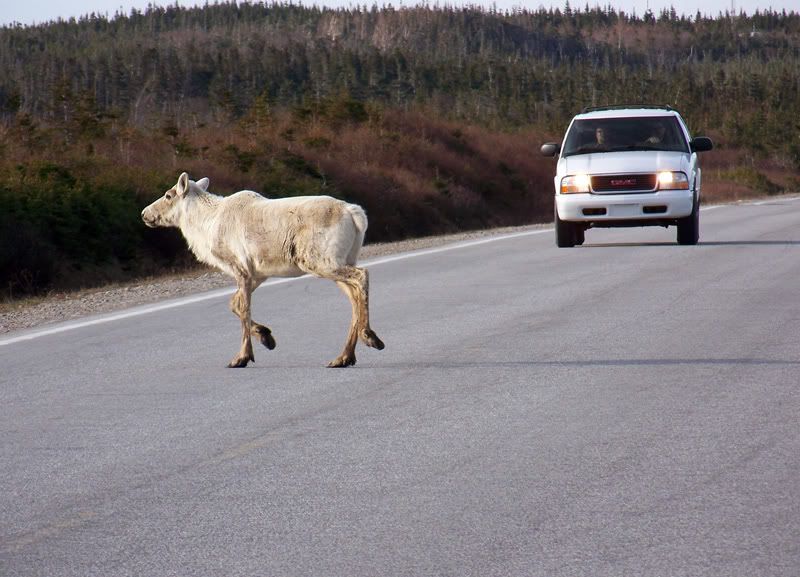
It sure was "highly visible red paint" they used on the caribou during the recent census survey. I captured this shot on the Viking Trail just North of Rocky Harbor yesterday. If a person didn't know what happened, i would suspect they would of thought the animal was injured. I wonder is it more easily spotted by a predator now? Bear,coyote?
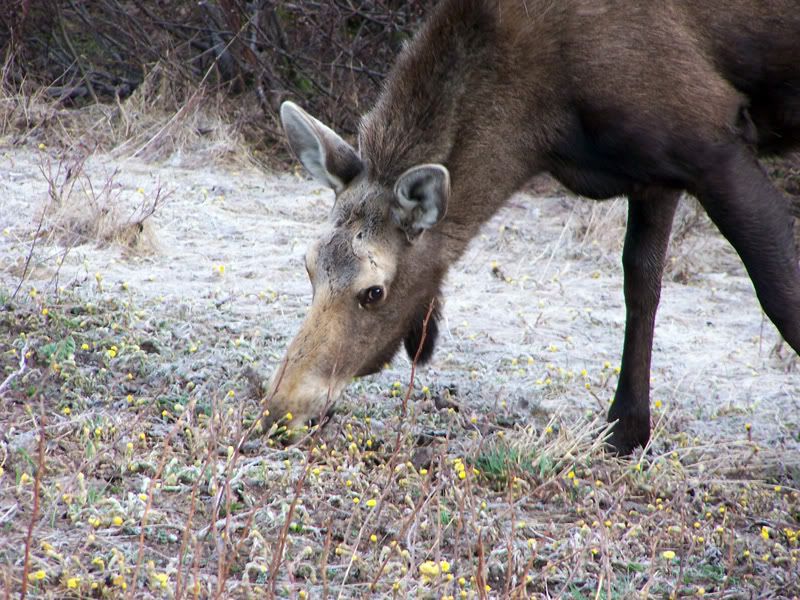
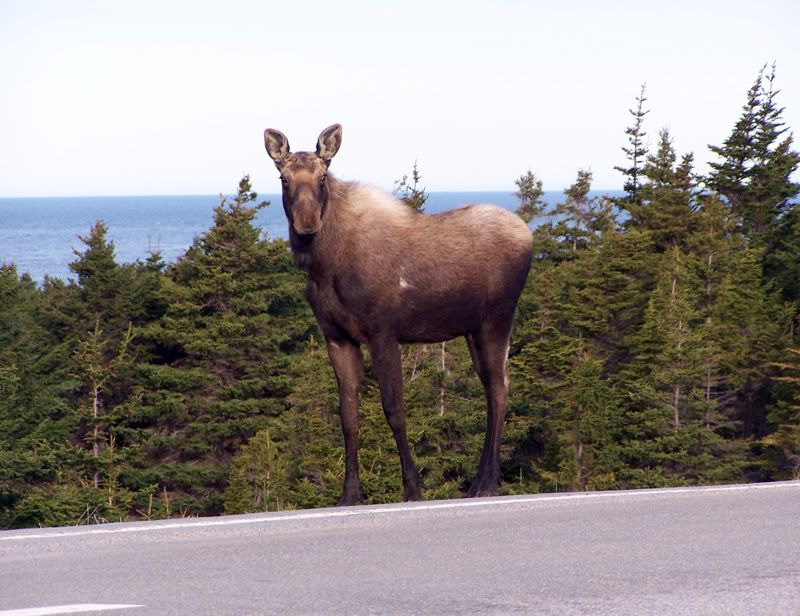
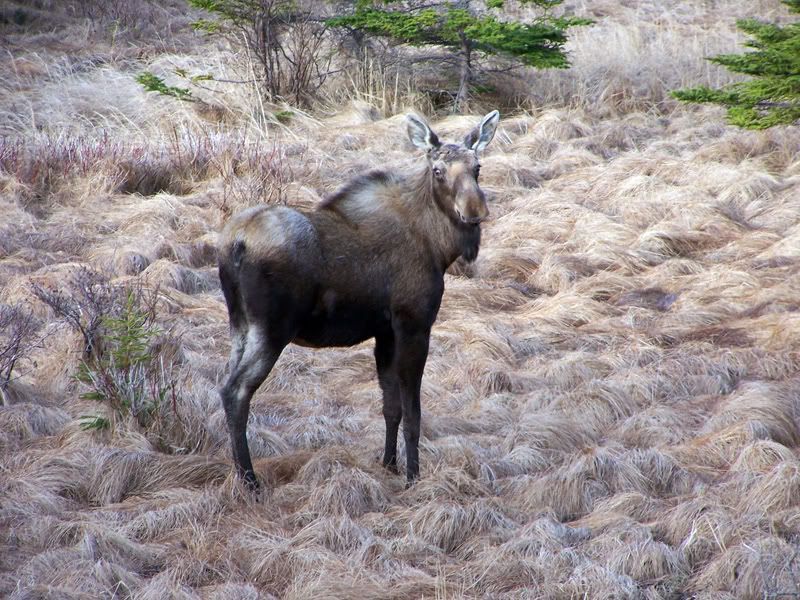
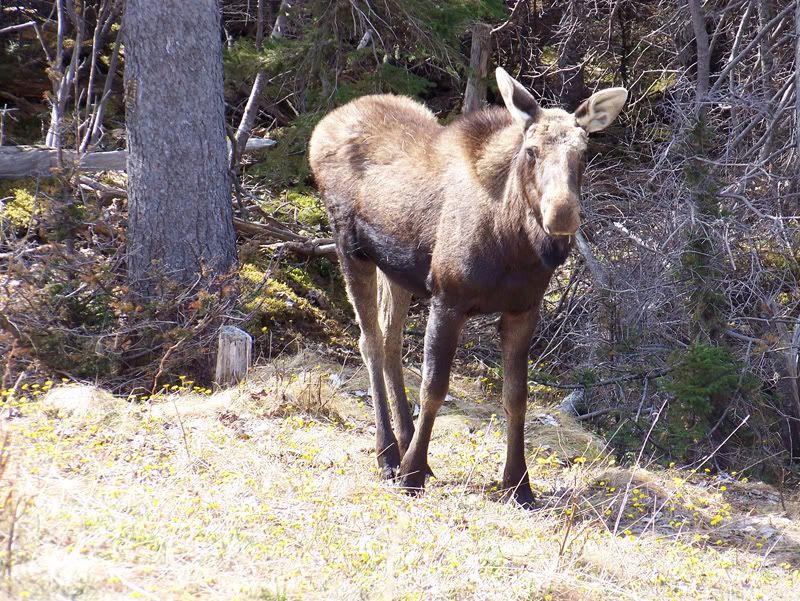
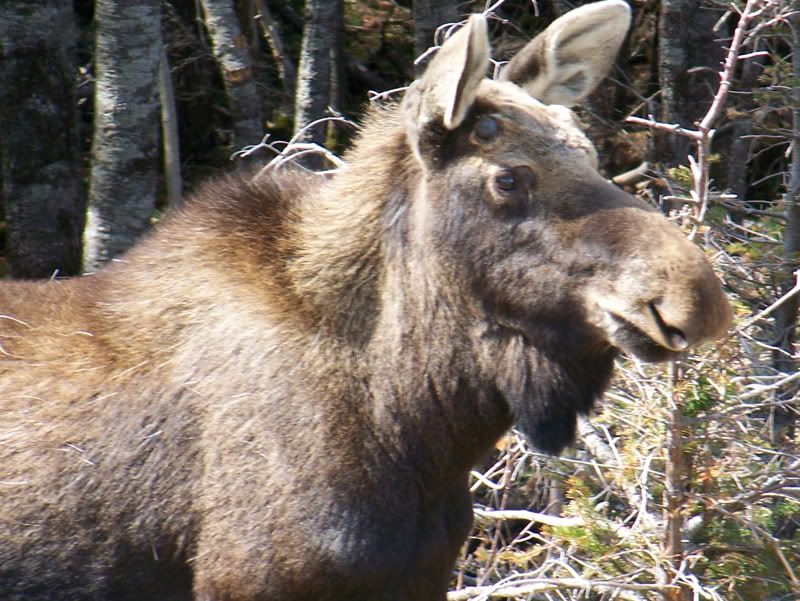
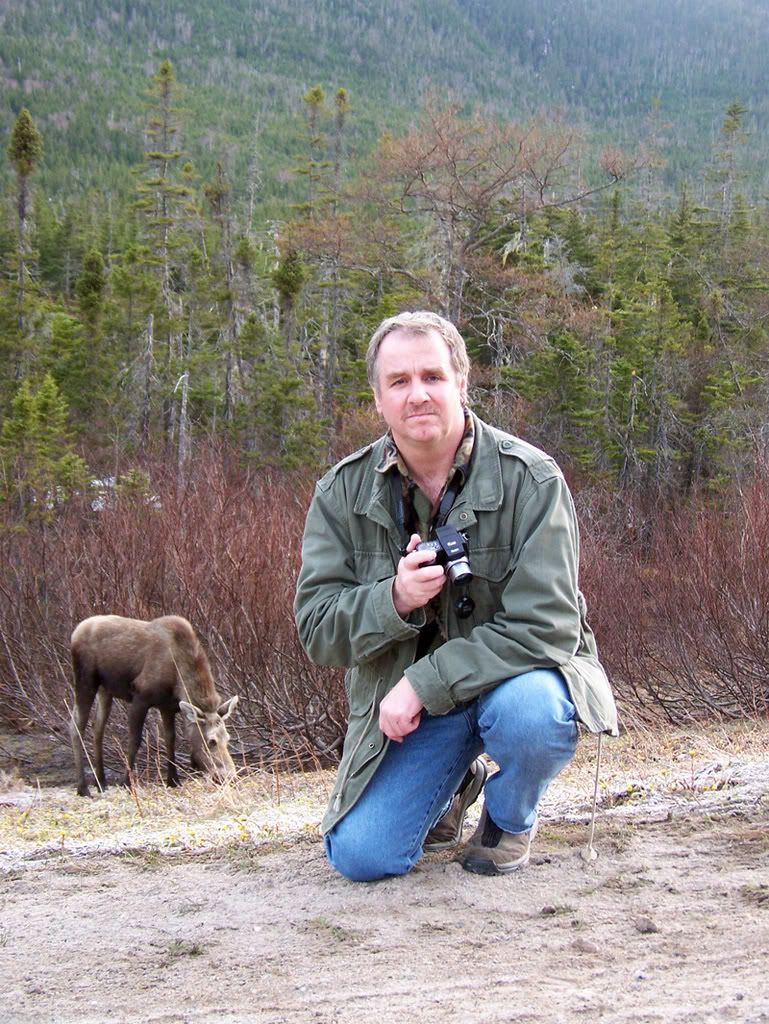
Few photos i captured in the area yesterday.

Saturday, May 03, 2008

Phase one of the census for caribou populations found on the northern Peninsula including the Gregory Plateau, Gros Morne, St. Anthony, Hodges Hills and Hampton Downs herds are out.
An estimate of 10,400 caribou has been announced after caribou from the herds had been marked using a so called highly visible red paint. A ratio of marked animals to unmarked animals was used in the estimation technique and another will be used in June when the caribou herds return to their calving grounds.
Hopefully in the next 48 hours depending on weather conditions i'll be traveling to Gros Morne. I do this every year to take a few shots of the wildlife in the area. I enjoy my little trips and it'll be far from a scientific outing but it's great to know that i'm sure to see some when i get there. Besides the Caribou that area has probably the highest Moose density in the world with about 8,000 moose roaming in the park area. The camera batteries are charged, cameras stored and the first stop will be Big Stop, Deer Lake Irving to sip a coffee before daylight Monday morning.
Subscribe to:
Comments (Atom)